For my year 2 FMP I have created a project called ritual, where I aimed to explore the different avenues people decide to perform repetitive ritualistic practice. I aimed to show the transition of repetitive human behaviour from traditional spiritual practices to modern day almost unnoticed behaviours. Initially, I intended to produce either a comic or an animation. However following my pitch I was proposed the idea of a motion comic and evolved my idea into something I haven’t tried before. This decision was a significant turning point and also differentiated my project from work I have done in the past. My goal was to show the viewer the parallels between what they respect as a traditional ritual compared to the activities and behaviours they interact with on a daily. Also how meditative rituals allow people to slow down and inhabit time instead of it passing them by in the extremally fast paced digital world.
The research phase was I believe the most significant phase of my project and it really allowed me to find the exact point and purpose of my project. My primary research confirmed that while people are less familiar with traditional meditation, they can find meaning in repetitive actions, also in music. This was crucial to the development of my project as I was able to link mediative actions to the nature of jungle and techno music, due to the repetition involved. My technical research led me to experiment with physical forms of art which from the start was something I wanted to highlight, due to my background in fine art. I decided to prioritise the development of the mixed media elements of my project over the digital overlays. This was a very important aesthetic choice since I had to follow my research and see that the hand draw look was a very important goal in my project and the last thing I wanted to do was distract from them.
Throughout weeks 5-8, I managed a complex workflow involving physical colouring and drawing, photography and assembling in adobe animate. One of my major obstacles was time management. In week 8 I realised that extensive digital transitions and motion tweens was too ambitious for the remaining timeframe. This is when I made the decision to focus on the visual quality instead of adding different elements, especially when a big goal of my project was trying a new way of creating a comic, and motion tweens and digital effects is something that I have done before. Using my own camera allowed me more control over the overall look of the frames and I was able to maintain the texture that I was looking for. My storyboard focused on symbolic transitions, such as monks beads becoming a necklace that someone wears everyday, meaning I was able to communicate my message without adding dialog through speech bubble for example, which is what the digital element would consist of.
Self reflection and conclusion
The final result is a motion comic that was able to bridge the gap between traditional and modern rituals. If I were to do this project again, I would allocate more time for the clean up phase to be able to add digital elements more subtly. However my decision to prioritise texture and symbolism in the frames of my comic was defiantly the right one since it resulted in a final product that is unique and I believe portrays the things I find important and the theme of my project.
This is my story board, I plan to show the transitions through physical objects such as the necklace in frames 1-5. It starts as beads that monks are using to pray, which is a common ritual during prayer. Then the beads shift into a necklace that a woman puts on everyday, representing the more day to day rituals that people have that they don’t even notice. This then will change into a group getting ready to go out, this is where the focus changes again to the repetitive ritual not only being peoples behaviours and the actions they do repeatedly, but the music that listen to, this is why I’ve included a party and DJ scene in my comic. Frames 9-10 are intended to represent the music being the repetitive ritual itself and genres such as techno and jungle being a meditative sound since the beats are intended to repeat. The comic then continues to go back and forth between modern and traditional rituals, frame 12 shows monks creating a mandala, I then wanted to have them making beats themselves as unusual imagery, to aid in the transition to the other frames.
The most difficult part of this comic will be including motion tweens and picking subjects to have move. The intention behind the moving parts of my comic will be to include more digital aspects to my projects and make the frames link to one another. I will do this once the frames are coloured and I have put them back into animate, once the frames are all lined up I will then be able to draw on top of them in animate, directly in the software.
Hand colouring frames
My biggest limitation in hand colouring the frames of my comic will be the paper, when colouring on adobe animation ad photoshop this is not something I have to worry about since the paper cant rip, and I don’t need to worry about the medium being to hash for printer paper. this is something I need to be cautious of, I am used to working will oil paint, however I believe this will not be an option, since it requires canvas. I will use this limitation as an opportunity however, to try new things, I plan to try coloured pencils and oil pastels and possibly chalk and see what effect I like the most.
However, in a case that the printer paper is too thin for the media I want to experiment with, as a contingency plan, I will use a light box and trace the frames onto thicker more durable paper, this will give me more freedom to get the effect I am aiming for. This will slow sown the process for production, and may mean I don’t have time to include motion tweens, however the mixed media element is the most important part of my project so I plan on prioritising this.
Photography vs Scanning
In my original plan, I was going to scan the images to create the comic however I ran into a few issues. Once scanned the images looked almost digital again, this wasn’t ideal since this was the look I was originally trying to avoid. The scanner was also harder to access so if I decided to change any of the frames it would take longer to go and get them scanned again.
To solve this issue I decided to go with photography instead, this way I was able to use my own camera meaning it was a lot more accessible and I believe it was able to capture the shadows and grain of the oil pastels well
As I enter the final phase of my project I’ve had to make decisions on what aspects of my project to prioritise. My original plan was to layer this carousel of my oil pastel drawing with digital animations and motion tweens. However, after finishing my physical production, I realised the physical texture is what appeals most to me, and where the most successful parts of my project.
I evaluated the remaining time that I had in weeks 8-9 and decided to prioritise the mixed media elements over the motion tweens. I found that also adding digital illustrations overtop of my textures that I worked hard to capture distracted from the hand- drawn looked I did most of my research on. This decision also came down to time management, I didn’t want to rush through the important part of my comic, to create a final result that didn’t portray what I intended.
After my pitch the feedback I received was very helpful, and suggested instead of choosing between an animation and comic, I could do a motion comic instead. This would be able to combine both ideas 2 and 3. This is something I would like to do for my FMP, because I’ve also never done one before so it would be a good challenge.
This is the survey I made to collect data on peoples daily rituals an their interest in music being involved in that. This will help with thinking of ideas for my comic and if people would actually be interested in it. it also talked about spirituality since i was unsure if people would like a comic about that.
A lot of the data I collected from my survey was mixed, such as asking about the atmosphere of the animation. I received equal results on each option, however it was clear from my other questions that this is a type of animation that people are interested in seeing, just not with a specific idea in mind.
I like the idea of a motion comic for my FMP, because I believe I will also be able to include some of my technical skill in painting, I believe this will make the project easier to manage since I will be including something I am more interested in then digital art.
I saw this animation on Instagram by @trashiok , it is his FMP for his first year of university. he used clip studio paint. I am not so much interested in the actual process of how he made the animation, but the common theme in his work of using physical objects as transitions, in this animation the train is a metaphor, and it also aids as a transition through all of the frames, making the animation more cohesive. This is an idea I would like to include in my FMP. I believe using physical transitions will help the flow of my comic, in the absence of a linear story. since my project will have selected motion aspects, I think using the same objects as transitions will give me structure on what parts to animate, because the parts that are moving with be seen as the most important.
With the physical objects being seen in different scenarios with ritual taking place, this will also show my overall idea of the rituals the different people are doing throughout the comic, though seem very different and unrelated are actually performed in very similar ways.
This is an example of a comic that utilises a hand drawn pencil sketch look, this is interesting inspiration of my project since it is still digital art however made to look like its drawn with pencil. this is almost the opposite effect I’m going for however still eye-catching.
I have done some tests for the texture and style I would like my final outcome to be like, these are still just ideas but I would like to explore different ways I can create this comic. In the past I have been unhappy with how smooth and clean drawing can be on a computer so I would like to use these physical textures somehow in my project, I like the idea of a mixed media animation, I like how the final outcome is more chaotic and will fix the issues I have with regular computer animation. I think this will also help me not get bored of creating this project, since the process can be quite repetitive and time consuming it will be more stimulating to use skills I have acquired in fine art.
I did these with oil pastels, I have never used them before but saw this project as the opportunity to try them.
These are some frames that inspired me, I found them on Instagram by @konstantin_defrance. He used 2d animation, painted textures an photography. I was interested with the fact that the storyline was almost secondary to the animation and the most interesting part was the visuals. This has influenced my project as I will focus more on strong visuals and imagery rather then a linear story, I plan to use abstract transitions between monks meditation in ritual to rave scenes where the repetition in the beat is almost worshiped.
Since there was so many different mediums used it was intriguing. Through further research I leaned they used a software called Tvpaint, I had never heard of this until now and this may be an alternative option compared to adobe animate.
For this project would like to utilise some of my skill in oil painting, and I would like this project to also reflect what I’m interested in. This is why I’ve decided to go for a hand painted look for the style of the comic. I was also inspired by one of my recent paintings, since it was so enjoyable to make and one of my personal favourites , this project has given me the opportunity to explore the subject of the painting further.
This is my storyboard, I have made it more of a layout of key frames , and the thumbnail of what I would like it to look like. I am trying to portray the similarity between all these activities and focusing in making the frames as eye-catching and interesting as possible, my goal isn’t to make the scene a realistic one but more obscure and blending things together that probably shouldn’t be. This is also why I’m not focusing on a linear story and more of a collection of scenes.
comparing animation software
Tvpaint vs adobe animate:
I used this video to see how Tvpaint is used, and the difference in brushes compared to adobe animate, I also watch the videos on the Tvpaint development YouTube account so I could understand the software more.
Tvpaint vs adobe animate comparison table:
Tvpaint
Adobe animate
Drawing style
artistic, hand drawn, natural textured
clean, sharp, digital look
Animation method
frame by frame
Tweening, motion tweening
ability
a lot of artistic freedom
structured, limited
workflow speed
slower, (due to frame by frame animation)
faster ( due to tools and tweening, keyframes)
type of software
raster, bitmap based
vector based
cost
one time purchase, offers a student discount
monthly subscription, free for students
Tv paint is know to be like drawing on paper, whereas adobe animation is more clean. the main appeal for me with tv paint is how it looks so much like real paper, so it would be best for hand drawn messy expressive animation that I have been inspired by. I’ve found that adobe animate has been good for cartoon like animation with sharp lines. it is less natural feeling since it is vector based.
Since tv paint is built more for frame by frame animation, adobe animate may actually be more appropriate for this specific project however , since it is built more for motion tweens and rigging, which is what I need for a motion comic. There is also a big price difference between the software meaning Tvpaint will be inaccessible.
Due to these challenges I have decided to adapt adobe animation to behave more like a hand drawn soft wear.
After watching this video, I have decided that instead of finding an animation software that mimics the hand drawn effect and will have the most realistic brushes. I have found it will be a better idea to follow the process of Dominik and draw my frames on animate and colour and texture them after printing them out, I can then put them back into adobe and continue to animate with motion tweens, which adobe is know to be best for. This way I have found that all the parts of my animation that are important are being done without using a software that isn’t made for that specific style.
Following Dominik’s workflow for my project, I will need to create a storyboard to know the basic idea of the comic, even though I am not focused on following a linear story I need to know what frame to draw next and how they will transition into each other. then I will create the main framework for the comic in adobe animate, these frame will not transition seamlessly into each other since it is not an animation. I will then print out my frames and colour them with pens pencils and paint to achieve the textures I an going for. then I will scan the frames back into adobe to create motion tweens to emphasis the motion part of the comic.
Halfway point reflection and evaluation
During week 5 of my FMP I would like to evaluate my progress so I can really understand the amount of work I have left to do. I believe I have made good progress in finding a theme and thinking of different ideas and how to portray them, I have done this by researching into modern and religious practices. I believe the research I still have to do is with the tools I will use to make my motion comic and I still need to test the brushes I plan to use and the colours. Also how I plan to construct it, and the atmosphere I plan to create.
My original aim and reason for creating my project was to explore the subject of rituals, this idea stemmed from video essays I’ve watched and the rise in people rejecting ritual in the modern day, due to ever changing expectations of people, from things such as social media, and its extremely fast pace. These things also have a tendency to make people lonelier and become more self centred. through my research I’ve learnt that rituals can aid your experience of time and help you slow down, with the focus being on the activities you are taking part in not on the self.
My biggest progression so far has been the decision to make a motion comic. Once I found my reason for creating my project I was then stuck on how I would like to portray my idea. I was stuck on the decision between a static comic or animation. This decision came from feedback after my pitch where I can combine the two, so I can embrace the speed of making a comic so the time restraints of the project aren’t a problem , yet I can also challenge myself with animated elements and trying new tools. This will also allow me to emphasise key moments in my animation and a variation between the frames to keep it engaging,
In terms of research, what catalyses the idea for this project was a video essay by Nina Montagne called “the disappearance of rituals and the exhaustion of constantly becoming” this helped me understand the important of ritual outside of religion, and the importance of ritual in peoples daily life.
Progress evaluation weeks 4-6
During weeks 4 to 6 in my project I was able to conduct research beyond deciding what theme to use and understanding my chosen theme of ritual. I was able to receive feedback through primary research from my peers through a survey which was able to guide me in the overall atmosphere of my final production. I also compare different software so see what would provide the best outcome for my project.
I also was able to experiment with different media, I believe this was the most impactful development through these past weeks as I was able to solve my issue with digital painting and colouring. I am also able to include fine art which I personally enjoy to make this project something I am more passionate about overall.
TVPaint Développement. (2019, February 7). Being a key animator in Japan with Ken Arto from Yapiko | TVPaint interview [Video]. YouTube. https://www.youtube.com/watch?v=uWXtTjXwYXQ
Krishnanandayani, J. D., & Chakraborty, E. (2025). The role of rhythm in religious rituals: Supporting the spirituality of Hindu-Buddhist communities in the context of eschatology. Life and Death Journal of Eschatology, 2(2), 64–78. https://doi.org/10.61511/lad.v2i2.2025.1615
For the first week of the FMP I want to focus on finding a theme for my project, I have though about using the one provided, however I think it would be a better challenge to think of one myself and also give me some more creative freedom. I also think it would be a good choice since there was a theme we had to use for our last FMP so it would be new to think of one myself.
For this FMP I am interested in creating a finished product overall, for example an animation including sound effects, following a planned storyboard, or a comic that is coloured and has a really wide range of thought out textures. This is something that is important to me because it would be improvement from my last FMP, I wasn’t able to finish my final animation because it took a lot more time to learn software since it was newer to me, however this time I am more confident in my 2D drawing and animation abilities and would like to create a cohesive animation sequence or comic.
Theme
The theme that I have chosen is ritual.
I think the most common perception of the word ritual is in a religious context, which is what I find interesting about it because it can be so broad, it can be something that you end up doing repetitively, however I like how it is something that is more important and is intentional. I found this theme appealing because I’m not religious, but I have many rituals in my life, and I don’t believe this is a personal thing, I think this is true to everyone. Getting ready in the morning, going to the gym, going to church, this all creates a certain structure in you life and is repetitive. I would also like to explore, are religious rituals and modern rituals actually that different?
I’ve used these articles for research on the importance of rituals, in a religious context and also in peoples everyday lives.I am interested in comparing these modern and religious rituals and how similar they really are and aren’t all down to worship.
I am also interested in the music used in sacred religious rituals and that compared to different genres such as techno and jungle. I find this interested because the appreciation for this music can be almost religious, however it isn’t taken as seriously as hymns or chants, and if its the specific music used that creates a deeper connection with the divine, or what it represents. Therefore it can be replaced with any genre.
idea 1
Rituals aid how we experience time.
When you focus on doing something in ritual there is less focus on the self and more on the actions taking place. This can appose the culture of endless self improvement of recent, highlighted by the use of new years resolutions and things similar. There is a cultural focus on hyper individualism and self optimisation. its very common to find meaning meaning through self improvement, usually focused on physical change, and this being confused with moral superiority. these can be isolating and potentially cuts you off from community. Of course not all bad because these things can create communities within common interest.
However those who devote themself to ritual must ignore themselves, they can produce distance from the self. Focusing on the activities taking place and what’s going on around you can make time habitable and not something your passing through to achieve exterior goals.
Animation
Portraying one characters life, day to day
Starts quickly (frame rate , scenes changing quickly) showing the passing of days, daily routines. Then ill choose one activity that the character includes in everyday and every time its shown the animation will slow down.
pros- I get to experiment with different frame rates
cons- similar to my idea on my first FMP
Idea 2 and 3
I would like to compare modern ritualistic behavior with more traditional ones.
The practice of monks meditation is something they do repetitively and is usually the first thing people think of when you think of monks in a monastery. These are the practices of spiritual discipline and they do this because its in line with their faith.
The repetition is what makes it important which is what I would like to link with jungle and rave music, using looping beats where the repetition is hypnotic.
They both also reduce the focus on the self, deep meditation is about feeling the world around you which rave culture can mimic, moving to music can induce a meditative state of consciousness.
Animation or comic
I am still undecided on whether i want to portray this idea through an animation or a comic
I would like to show monks meditating in a monastery, and the rituals they do while meditating (such as the importance of music and breathing patterns) slowly turns into them making techno and jungle beats, not as a replacement but to show that the nature of them both are actually quite similar.
I think that portraying this idea in an animation may be better since music is very important to the overall concept, however i have never made a comic before and i think it may be a bit more achievable within the time frame.
I think a comic could be a good contingency plan since it is similar to a storyboard that I intend to do for my animation anyway.
The first three weeks of the FMP where dedicated to idea development and finding a theme for my project. I decided to not go with the theme provided since I wanted to challenge myself, also since I didn’t get an opportunity to choose the theme last year.
Once I had found my chosen theme ritual, I focused on researching the dictionary definition and also the phycological definition to prepare for my pitch. The feedback I received helped a lot with deciding on the production on my project. After receiving my feedback I was able to go into the next section of my project- Research
Explain what you have discovered about this group and outline your plan to appeal to them. Conduct research to support your choice and understand what your audience is looking for in a project. Continuously gather feedback from peers at every step of the project. Use this feedback for reflection and learning.
Cycling MK are a very passionate group who believe the cycling can change MK for the better. This is an environmental motivation mainly, however they also find cycling can improve peoples mental health, somewhat more then other types of exercise since you can do it in groups.
I plan to appeal to teenagers between 16- 21 and encourage them to start cycling, I think a survey would help with this, as I would be able to understand what is stopping them from cycling in the first place. It is also because cycling MK have found that the reason people aren’t using bikes isn’t because they don’t have one, they have found there are plenty, people just aren’t using them.
These are the results of my survey, I found that its very common in young people to be interested in street art, and there also being a lot of barriers stopping them from dong so. this has help me develop my idea and understand that it is something that young people would like.
I also found that environmental factors like rain where stopping people from cycling, this gave me the idea to make this a sheltered experience, so it wasn’t so whether dependent.
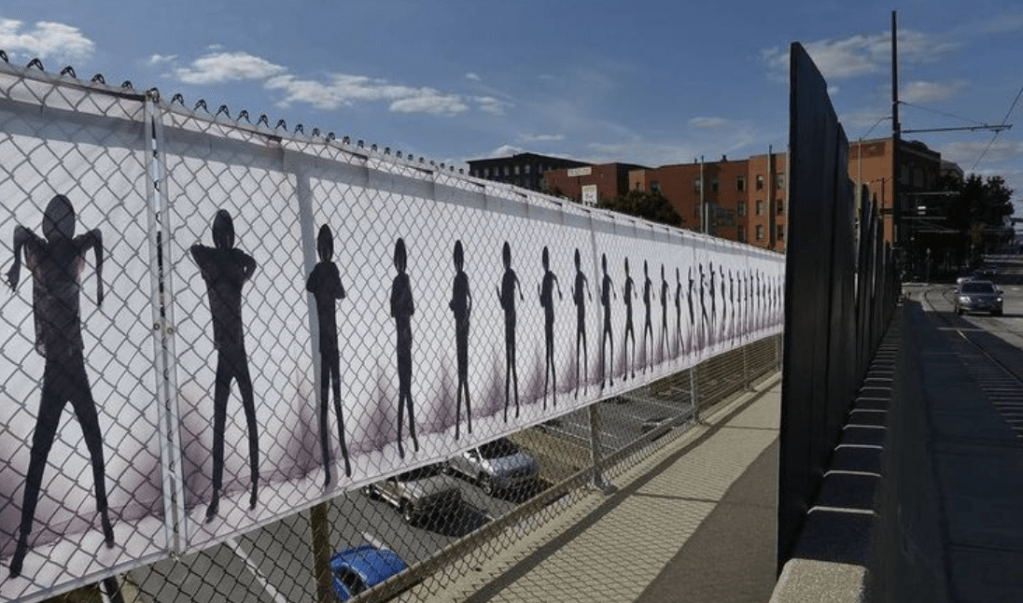
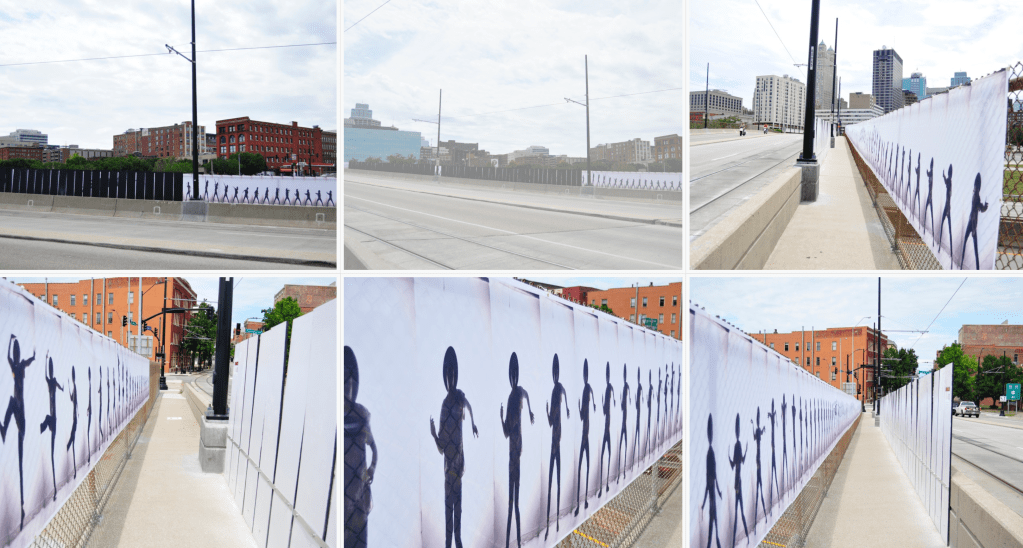
Life Turning will be installed on the Main Street Bridge as it crosses I-35/I-70 on the north side of the loop.
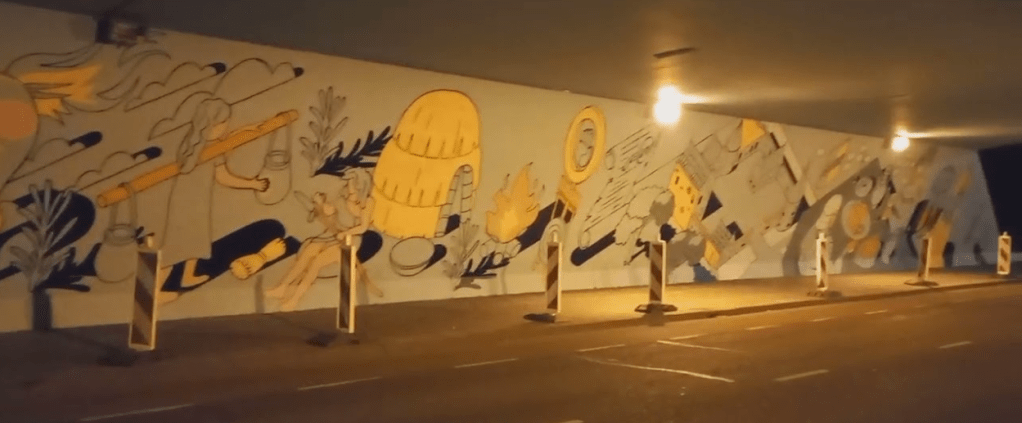
This is my inspiration for my unit 10 project, I have found that there is a recent interest in graffiti in young people. Maybe since it is a public way of self expression or an activity that is looked down upon however is a good way of bringing people together. This is something that teenagers can do in groups and manages to make the urban environment more appealing and colourful. I have found that this can link to cycling very well, especially with people using there bikes to commute, they pass railways and underpasses and with interesting street art to look at, it makes it a more enjoyable experience. Possibly having people who go on there bikes simply to see the art.
This is where I also found animated street art, I found this especially interesting since this is something people will only notice cycling, along long bridges or underpasses is personally what I find the most boring and least enjoyable about cycling somewhere, and if that can be switched to something you go out to see it could make a real difference in the amount of teenagers choosing to use there bikes.
This is my mood board of some example of street art, I have found it difficult to find examples of art that is more like a physical animation or linear zoetrope like the piece Life Turning, however these are the areas I’m intending to target with this project.
These are my plans for a linear zoetrope experience, this could be a set up along a long bridge in mk where members of the public can cycle through and see the animation take place. This will be something fenced off so people can cycle safely. I believe this could be appealing to groups, and something that families can do together, hopefully cheap with help from the council. I think Wolverton Viaduct could be a good location for this experience as I have noticed there are a lack of parks and things for teenagers to do in that area.
I believe that this project has met audience needs since it can provide an experience that people can go out an do, which i think is especially important in Mk where there s a lack of third spaces teenagers can spend there time. Since I also found that teenagers enjoy cycling because of exercise I think this is something that could serve a purpose similar to a skate park, where people don’t even realize they are exercising.
What you have learned about applying for next steps and what your thoughts an opinions on different ways of communication are.(1000 word limit)
Applying to next steps has definitely been a valuable experience for me, as I’ve had to consider what I genuinely enjoy and what’s important to me and navigate that in a way that is realistic, and what I think will benefit me the most- even when I don’t know what that is. I have considered many options of what I’m going to be doing in the next few years, since I didn’t enjoy the course as much as I hoped and right now I really cant see myself in a career to do with games or digital art. This is when I’ve had to communicate the most and talk to different people in what they recommend, and taking different opportunities to see what could possibly stick long term. This process can feel quite unstable especially with e-mails and digital applications, they feel quite frustrating to rely on.
Personal statement
Why do you want to study this course or subject?
I want to study dental technology because it combines precision and creativity in a really unique way that I find extremely interesting. I am particularly drawn to the technical and artistic skill needed to succeed in a career in this field, and creating something that will have a lasting impact on peoples lives. Dental Technology appeals to me as a reliable profession with clear progression, including hands on work and attention to detail. I am motivated by the responsibility of contributing to the patients care.
How have your qualifications and studies helped you to prepare for this course or subject?
Through my Level 3 qualification in Games, Animation and VFX, I gained many valuable technical and creative skill. I especially appreciate my new found knowledge in 3D modelling and working in a digital space. I also learned that although similar to my interests, this path wasn’t for me and I couldn’t see myself there long- term. However, I value the resilience and discipline I gained from persevering and completing the full duration of the course.
What else have you done to prepare outside of education, and why are these experiences useful?
Outside of formal education, I enjoy developing my skill in painting, oil painting specifically. This has strengthened my patience and attention to detail. Portraiture is my chosen focus, as I enjoy the knowledge of anatomy being a vital part of creating a harmonious, thoughtful piece. Being interested in fine art has made me more sensitized to subtle textures, colour matching and values, all of which I will be able to transfer in a career in dental technology where aesthetic accuracy is essential.
ai ethics of- , whether its a tool or replacement for artists, value of hand drawn art in the industry, therapeutic effects of art, whether art needs purpose, ethics of critiquing art
As an artist interested in oil painting as a hobby this question is very important to me , as critique plays an important role in how I view my own artwork. I can see both sides of critique being a positive way of improving your art and growing yet, I lean more towards the opinion of it being unnecessary, if your art is made simply for the enjoyment of being creative. Critique can be seen by many as a necessary tool for development, however can excuse harmful commentary in some cases, leading to a swing in the opposite direction where people begin to rethink the purpose of art as a whole. This report will explore the ethical consideration involved in critiquing and judging artwork, including the critical and supportive viewpoint.
In line with critique in art being a morally right thing to do, it can be believed that ethical critique can lead to a deeper understanding and appreciation of the work proposed. Criticism can sometimes help audiences notice small details that would go unnoticed if not pointed out, this leading to the work being appreciated in a different way. Some may argue that the longer you can get people to look at you art the more valuable it is. “Critics can help audiences perceive subtle qualities of art and situate works within wider artistic practices, improving appreciation beyond personal taste”. This criticism is able to take people out of there initial idea of what the work was supposed to be and encourage a different view.
Critique can also allow people to be held accountable for the art they create, if a world existed where it was completely non-existent to critique peoples work, in general whether it was in the fine art space or not, people would go unaware of potentially harmful subject matter being presented in their work. This caused by not having different perspectives involved in there creative process. This idea can be highlighted by bell hooks work in the book, art on my mind. She emphasises that if peoples voices, especially marginalised groups, are not heard then people will be unaware of potential prejudice. So perhaps being hesitant to critique peoples work believing that is the morally incorrect thing to do, may actually have the complete opposite effect if the subject is unethical in the first place.
In my opinion the biggest reason that critique in art can be positive, is more so that it can be provided in neutral spaces, where the art created doesn’t have any emotional ties. This is spaces such as workplaces or schools where the artist isn’t creating just to make something to represent themselves its for an ulterior motive, pay check or grade. This is when the argument of the artist improving has the most support. In school for example, improving ones artistic ability is somewhat a choice you make, and the reason to be there. All this meaning the critique intended to be constructive is asked for and there to be used. This therefore makes the criticism completely necessary, and no longer a judgment.
I began this report strongly on the negative side of this argument, since my perspective is from creating art out of enjoyment, a space where the critique feels alien and unnecessary. I believe that a major ethical concern is that critique can cause emotional harm on an artist, and depending how severe even cause them to stop the project all together. With this in mind it is then hard to believe that the one criticising had the best interest for the work in the first place anyway.
Due to the nature of art, specifically fine art, the medium is almost completely subjective. This I believe makes criticism almost impossible to “correctly” deliver. In line with what I have previously mentioned ,constructive criticism in a work environment, where the art needs to become something specific, is a different form of creating altogether. An artist creating independently, for the sake of a hobby or enjoyment, potentially has no end goal. This poses the question of whether the work needs to be optimised at all. What one critic will see as powerful about the piece another wouldn’t even notice. Similar to the technique or overall quality of the work, everything becomes completely based on personal taste.
Critique in art can also be argued as potentially immoral when you consider peoples different cultural backgrounds, with art also being subject to contextual misinterpretation. Critique can become unethical when it ignores cultural context. Art created with specific cultural, social and historic framework can be misjudged and not understood completely. Bell hooks also touches on this concept, she warns that without cultural awareness certain critique can be ignorant, and reinforce harmful beliefs.
It can also be questioned whether the digital age has warped the intake of critique, and now instead of notes in margins or written feedback in a classroom, the commentary is almost always public. This blurs the line between harmless criticism and harassment. A popular opinion online can snowball into personal attacks when a vast number of people are involved with differing morals. This is a more popular environment then ever for critique, and especially new artists will see social media as the perfect place to share their art. however this platform can lack professionalism and care, due to a lack of accountability involved .
In conclusion, through the information I have gathered throughout doing this report, critique in art can be necessary when it is applied in certain contexts, and not others, since it is a complex and multifaceted subject. I have now learned that you need to consider the purpose of art and the cultural significance of a piece of work to be able to critique it as correctly as possible, and with these things considered critique isn’t something that exists only for people outside of the creative process. Critique can be something that makes the art something more and in some cases without it the art wouldn’t be as valuable.
bibliography–
Berys Gaut. (1998). 7. In: Jerrold Levinson. (Ed). The ethical criticism of art. Cambridge: Cambridge University Press. pp.182 – 203.
Bell hooks. (1995). Art on my mind. N/A: The New Press. p.all pages.
Linda Caroll. (2025). The difference between critique and criticism is the size of the ego. [Online]. Substack. Last Updated: Aug 26. Available at: https://lindac.substack.com/p/in-defense-of-kindness [Accessed 22 January 2026].
A portfolio is a collection of your best work or piece you think represent your style and progress the most, it is helpful to have a range of styles and mediums if its an art portfolio or different skills if its for job applications.
Is a portfolio different depending on what part of Games, Animation or VFX I go into?
Yes, usually your portfolio will be more saturated with the skills you have developed the most, whether its 3D or 2D, or the software your most comfortable in. However its still important to show you can adapt and develop multiple skills to a decent standard
What do I need to produce in my own time to develop my portfolio further?
Experimentation is important to show multiple skills, and these pieces don’t need to be very impressive overall, its important to show the process, such as sketches or reverence to create a better understanding of your work process.
Can you provide a guide on the DO’S and DONT’S of a portfolio?
DO’s – Start with the work your most proud and interested in, so you can be recognized for the work you want to continue doing,
DONT’s – Don’t make it to word heavy, make sure to focus on showing your experience through projects you’ve done
Teamwork can make problem solving in a group a lot easier as different perspectives can find a solution more efficiently
Don’t work with friends
Roles – setting roles in a group can help assign people to jobs that they are the most comfortable and experienced in
Compromise – This is being able to assign roles and be able to resign to someones else experience in specific parts of the project
Communication – this includes listening and being open to other peoples ideas, as well as being able to suggest your own
Project Brief: Environment
Theme: Explore the concept of “Environment” through Games, Animation, or VFX. This could mean natural landscapes, urban spaces, futuristic worlds, or even abstract interpretations of what “environment” means to you.
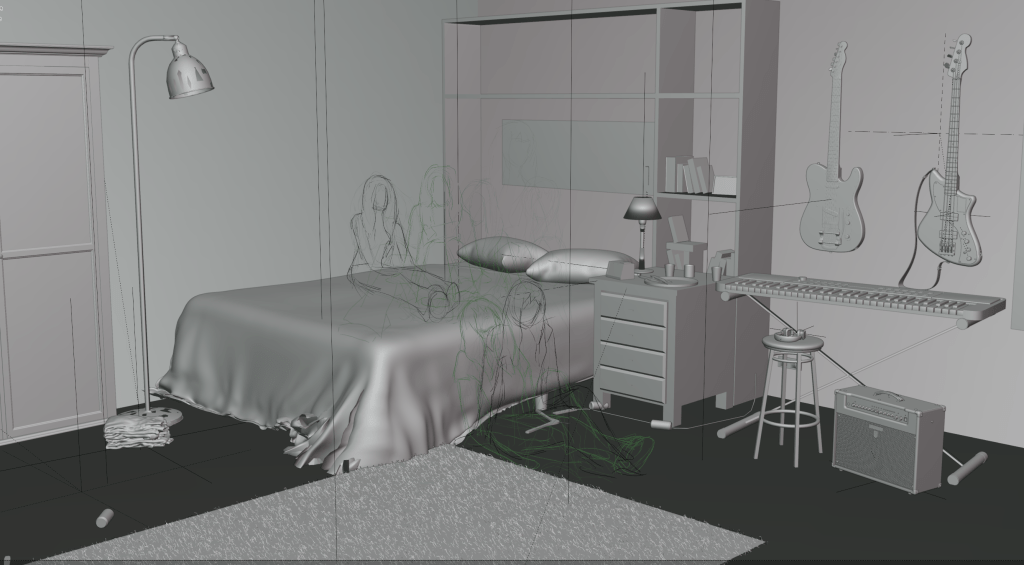
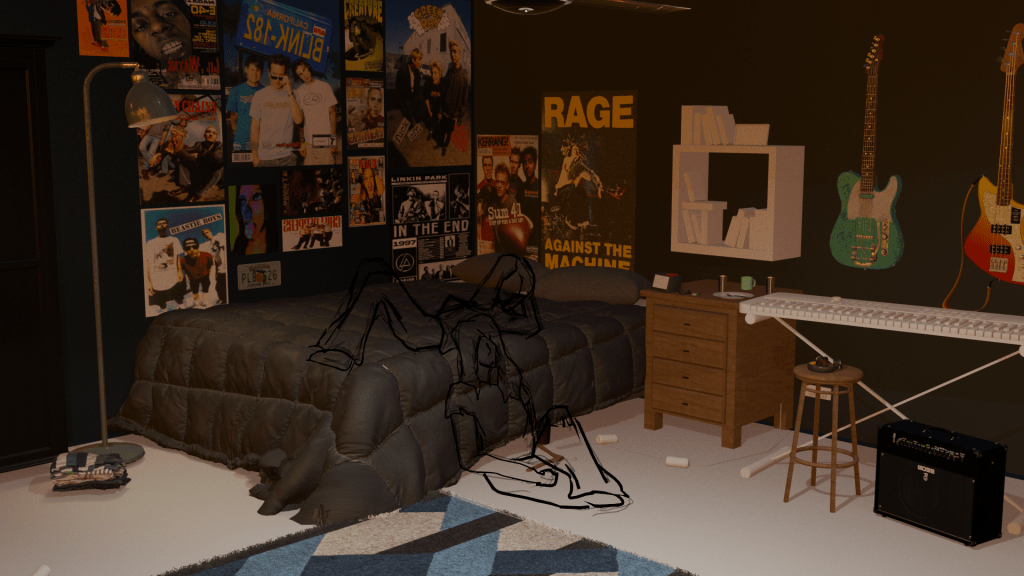
The goal for this project is the reflect the environment and dynamic between people after a party, the final render will show a teenagers bedroom cluttered with music posters and mess, with 2D characters drawn over the top.
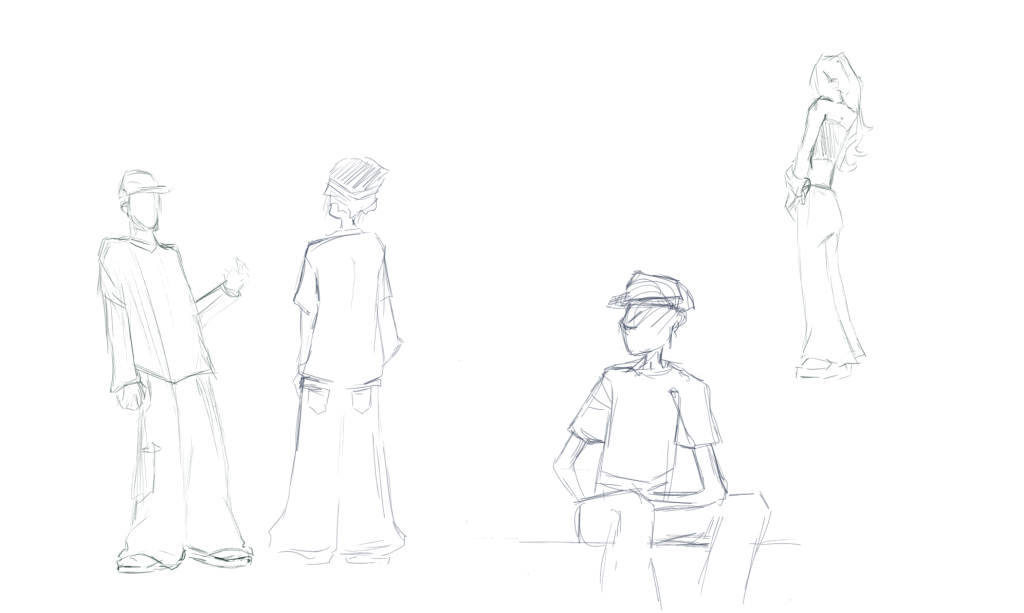
These are a couple of sketches from when I was figuring out the style I wanted to use for the characters. I didn’t want the proportions to be too realistic, similar to when cartoon characters proportions are supposed to be dramatic. I also want the characters to stand out against the 3D background, I think if I tried to draw them realistically it would not only take a very long time but the animation would lack contrast.
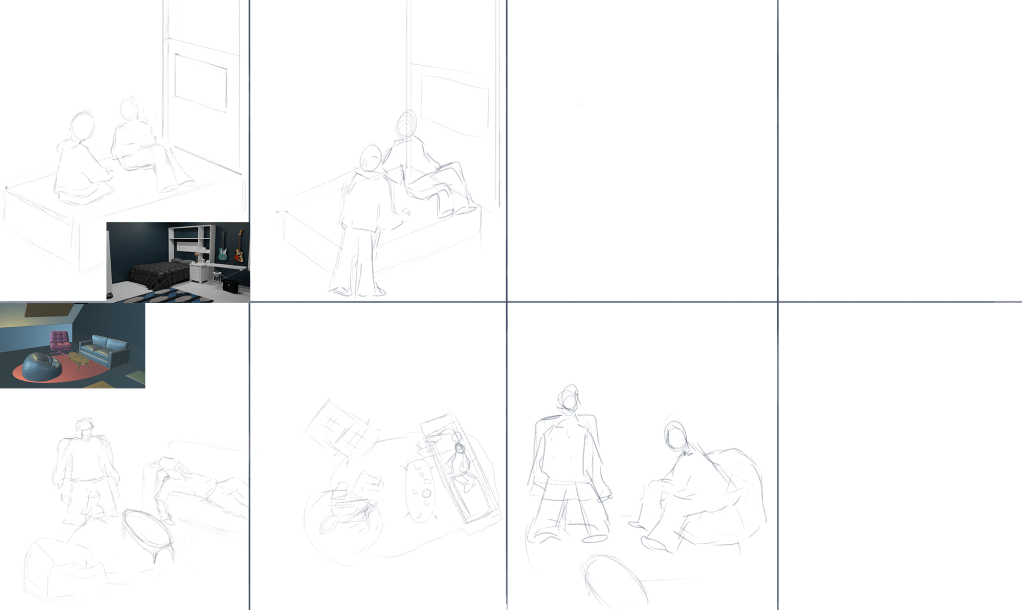
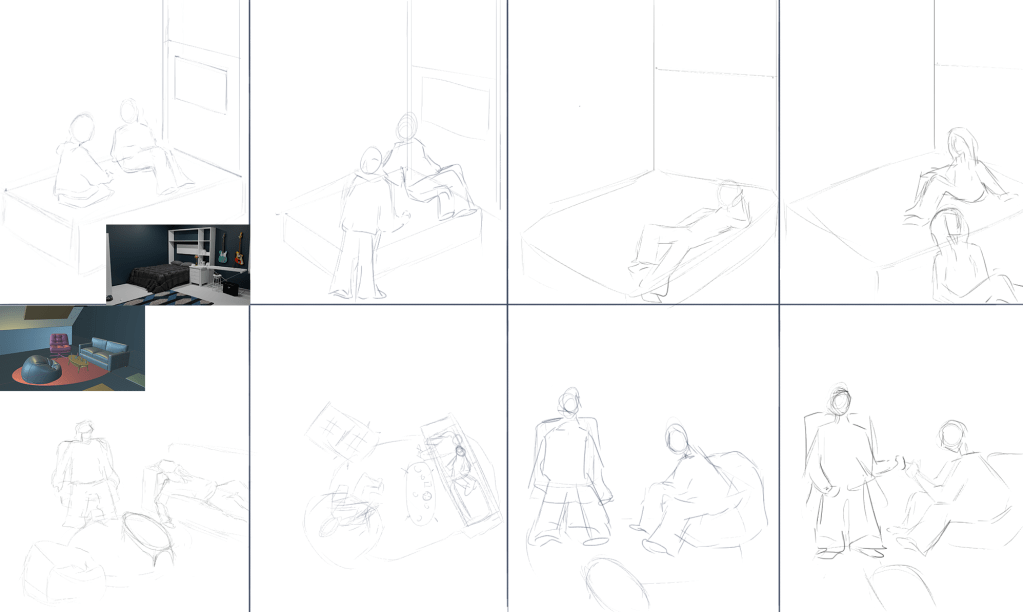
These are storyboards for what I plan the characters to be doing, I did these to mainly give me ideas on what to draw since we don’t have a linear story to follow, the main idea we are trying to highlight is the environment created in contrast to chaotic night. So I just needed to plan some of the movements, I also took into account the positioning of the furniture so I used Harry’s block out as a guid.
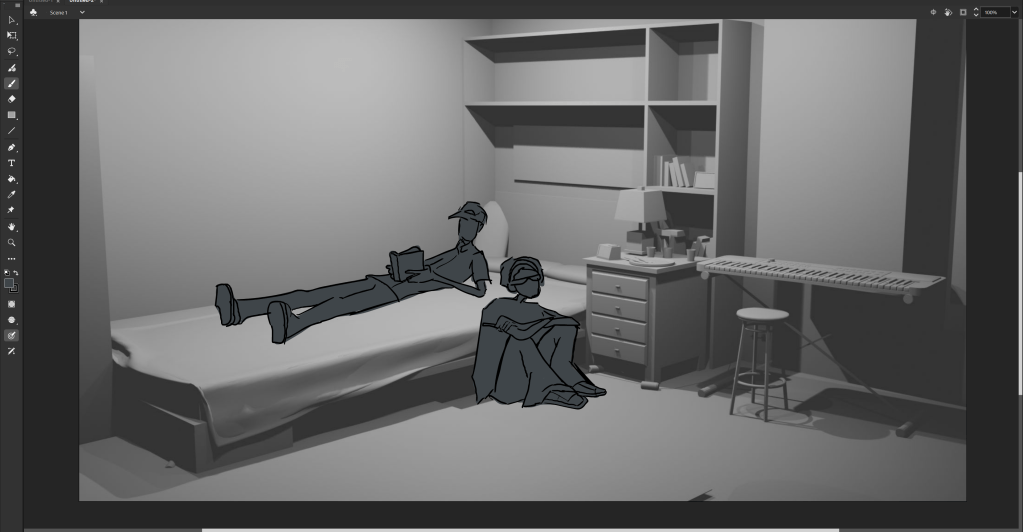
This is the result of using animate to draw a couple of the frames and while drawing I didn’t run into any problems as I used the same process and techniques I’ve used to animate in the past, and its a familiar software to me. However since I have to account for the 3D aspects this project it is different compared to any others I have done.
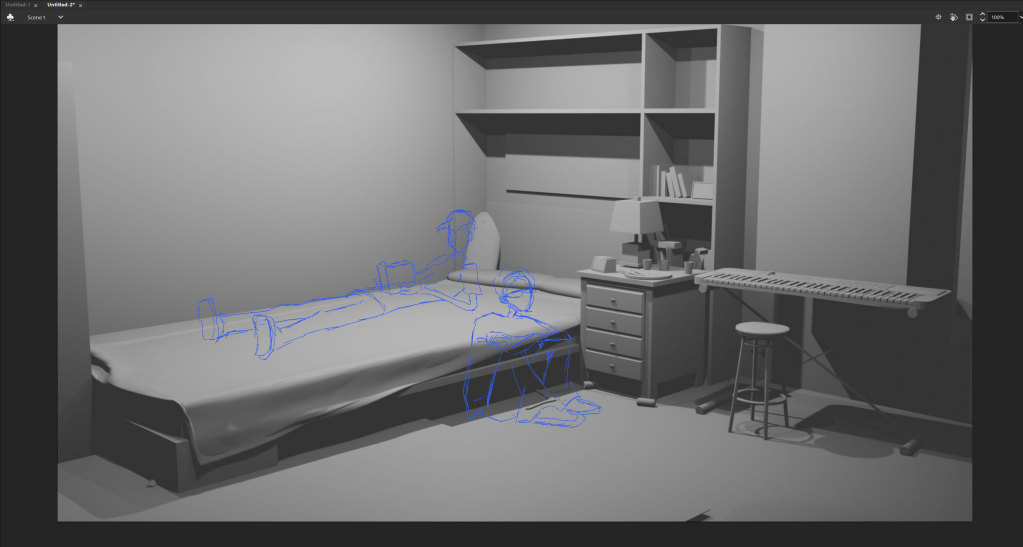
I found that animating over the top of the 3D render in a 2D space like adobe animate would make the perspective difficult to work with, and it also wouldn’t look very cohesive. so as a change of plan I decided to learn the basics of grease pencil in blender. This would be difficult since I am not familiar with the software, however for the project it would improve the look of the final product and it would make it easier to work as a group since we are using the same software.
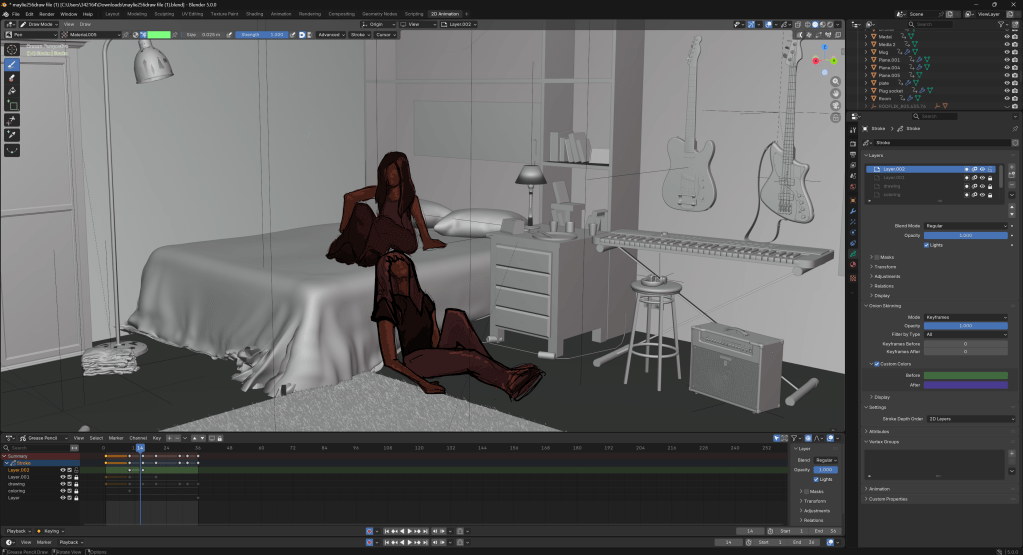
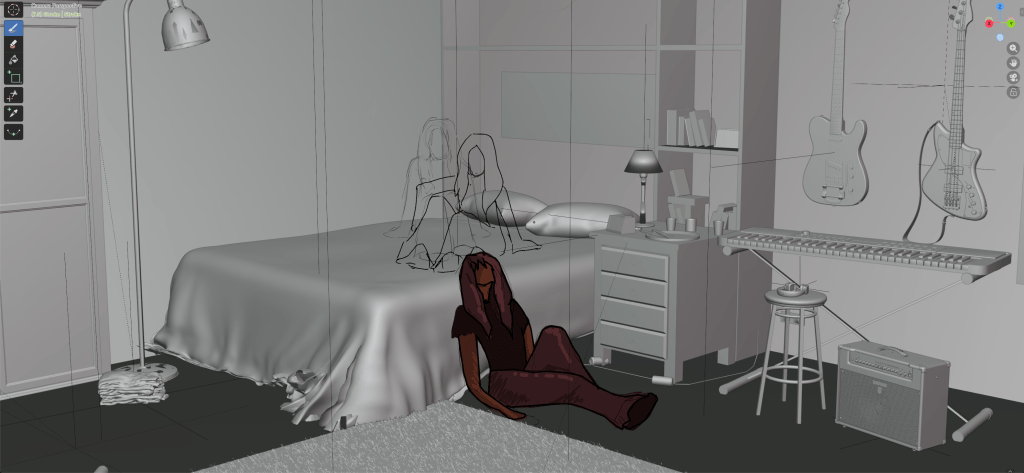
I’m able to draw the characters directly onto the scene, this has alleviated the stress of the perspective being off since I don’t need to worry about the scene underneath just being a screenshot. So if there where any issues we could fix the easier and also means we can just amend the drawings into the finished render of the room.
This video was very useful for learning just how the basics of grease pencil worked and i found it very helpful since it highlighted which parts I can treat like any other animation software (which parts are similar to adobe) and which are specific to blender. some things i found difficult to get my head around where having to lock layers you aren’t using, because this would mean it would erase the layers underneath. I also had trouble with the brushes, i found that they where quite limiting , and with further research I could probably find brushed i can download, but with this being my first project with grease pencil i wanted to get familiar with using it first.
I found a lot of the shortcuts where similar to software I’ve used before but the keyframes and layers will take a lot more practice to get used to.
I also found the onion skin more confusing compared to animate, it ended up auto looping the animation which made it quite difficult to work on the starting frames of the animation, however once I had a few frames down this wasn’t a problem.
This is the range of brushes I had, I ended up using the pencil soft for the sketches and the marker and pen for the lines and colouring. This is something I would change once I was more experienced in the software, because I found it didn’t give you choices on how your animation would look, as you cant choose between different textures.
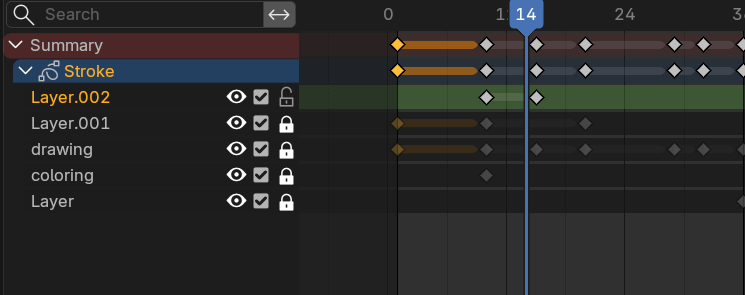
These are the layers of my animation. There are a few that are default that blender puts there for you, but I didn’t end up using these. The keyframes are something I had trouble with figuring out in the beginning and had to watch the video a few times over, but i got the hang of it eventually.
Another thing that helped me was using video references, this is something I’ve used before for an animation project and I find it helps so much more then photos, the process is similar to rotoscoping however without tracing the frames, you can just see how each movement looks slowed down and it makes it so much less overwhelming a confusing to animate people.
A goal for this project was to feel more comfortable animating in a 3d space and diversify the software I am able to use, I feel like I have achieved this goal, before this project I didn’t even know what grease pencil was, but now I am able to navigate it in a way that i can produce drawings. I also wanted to experiment with colouring is the most simple way i could while still being able to portray shadows and highlights, I have found in the past that the colouring is the most time consuming part of the project and I really wanted to cut down on it this time.
I am disappointed I wasn’t able to finish the animation, however I made this goal when I was still intending on drawing on adobe animate, so I was much more ambitious since I am more confident with the software. I am glad I got the opportunity to learn grease pencil though, and I think this is a positive outcome of this project, I am interested in continuing learning as well, and being able to use it more comfortably.